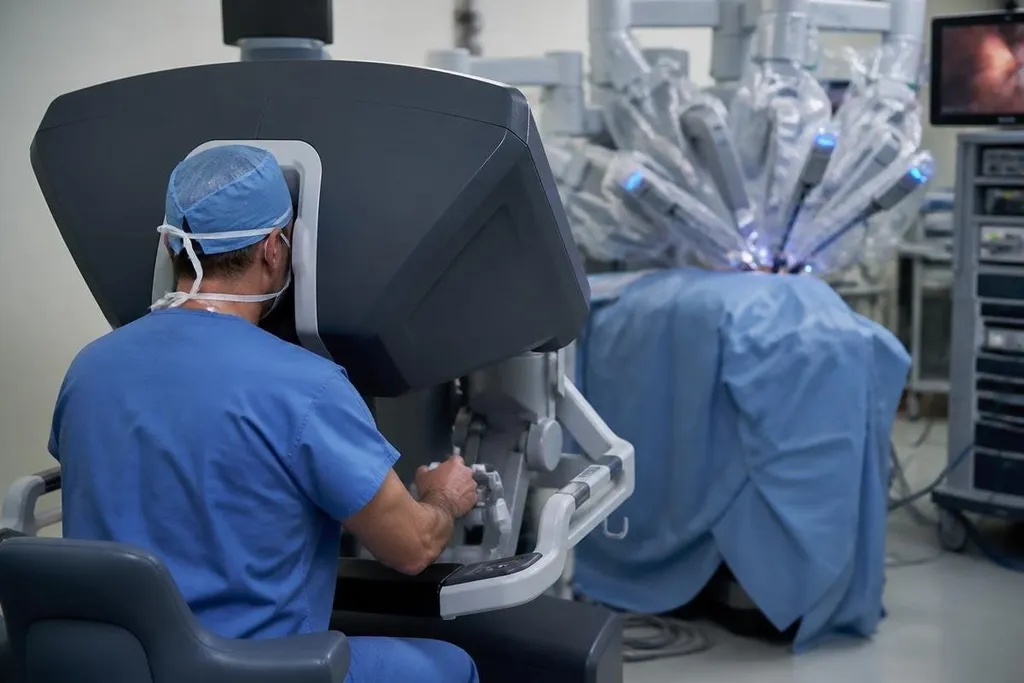
Surgical robots already let a surgeon control small instruments through a console. AI adds software that can read images, suggest actions, and check movement while the operation is under way. The main change is decision support, not a robot operating alone.
- Image tools can help mark tissue and plan instrument paths.
- The surgeon remains responsible for the procedure.
- Safety checks matter more than flashy demonstrations.
Where AI fits in the system
A surgical robot has several parts: a camera, instruments, motors, control software, and a surgeon interface.
AI can sit inside the software layer and process data from those parts while the surgeon works.
One use is image analysis. The software can examine video from the surgical camera and mark areas that may matter to the surgeon. This could help separate healthy tissue from a target area, but the result still needs a human check before anyone acts on it.
Planning is another use. A surgeon may set a target area and a safe route, then review a suggested instrument path. That path can account for the tool’s reach and nearby structures. The surgeon can accept it, change it, or ignore it.
Movement is another area. A robot can filter hand tremor, keep a tool within a set boundary, or slow movement near a protected area. These functions work through control rules and sensor data. They don’t give the robot permission to make medical decisions on its own.
What changes for surgeons
The surgeon gets more information without leaving the control console. A system may mark a structure in the camera view or warn when an instrument nears a planned boundary. That can reduce the work needed to watch several data feeds at once.
The software can also record the operation as machine-readable data. That may help teams review tool movement, camera views, and timing after the procedure. The value depends on the data being accurate and on the hospital having a clear reason to review it.
For surgical teams, the useful question is whether an AI feature has reached patient care or remains in a lab. Robot24.com’s surgical robotics reporting can tie a claim to the named system, hospital, task, and date, giving you facts to check before the surgeon weighs its limits.
The surgeon still has to understand the patient, the anatomy, and the limits of the system. The software can process a narrow task quickly, but it does not replace clinical judgment or responsibility.
The limits that matter
Medical data varies from one patient to another. A model trained on one group, camera system, or surgical method may behave differently with another. A useful result in a controlled test does not prove safe use across every hospital.
The system can also make a wrong suggestion with a confident-looking display. That creates a specific risk: the interface may make uncertain output feel settled. Hospitals need a clear way to show when the software lacks enough information.
Training data raises another concern. Patient records and surgical video need careful handling. Hospitals must control access, record how data is used, and explain who can change the software.
Fully autonomous surgery remains a separate and harder problem. An automated system would need to read changing anatomy, react to unexpected bleeding or movement, and choose among medical actions. Those tasks involve more than moving an instrument along a planned path.
I’d judge an AI feature by how safely it helps a surgeon check a decision, not by how much of the operation it claims to run.
A practical check before buying or using one
A hospital team can ask these questions before accepting an AI feature:
- Name the task: Does the software mark images, plan movement, control speed, or do something else?
- Check the evidence: Has the maker shown results from the same procedure and camera setup?
- Keep human control: Can the surgeon reject a suggestion and take manual control at any moment?
- Test failure cases: What does the system do when the image is blocked, the tool moves unexpectedly, or the data falls outside its training set?
- Plan updates: Who checks a software change before it reaches an operating room?
These questions connect the software to the work it must support. They also give a hospital a way to compare a real safety function with a broad AI claim.
What happens next
The next useful step is likely to be narrow AI support: image marking, movement limits, and planning tools that keep the surgeon in control. Wider autonomy will need more clinical evidence, clearer approval rules, and systems that show their uncertainty.
For now, the strongest case is a robot that helps a surgeon see and move with better information while leaving the decision in human hands.